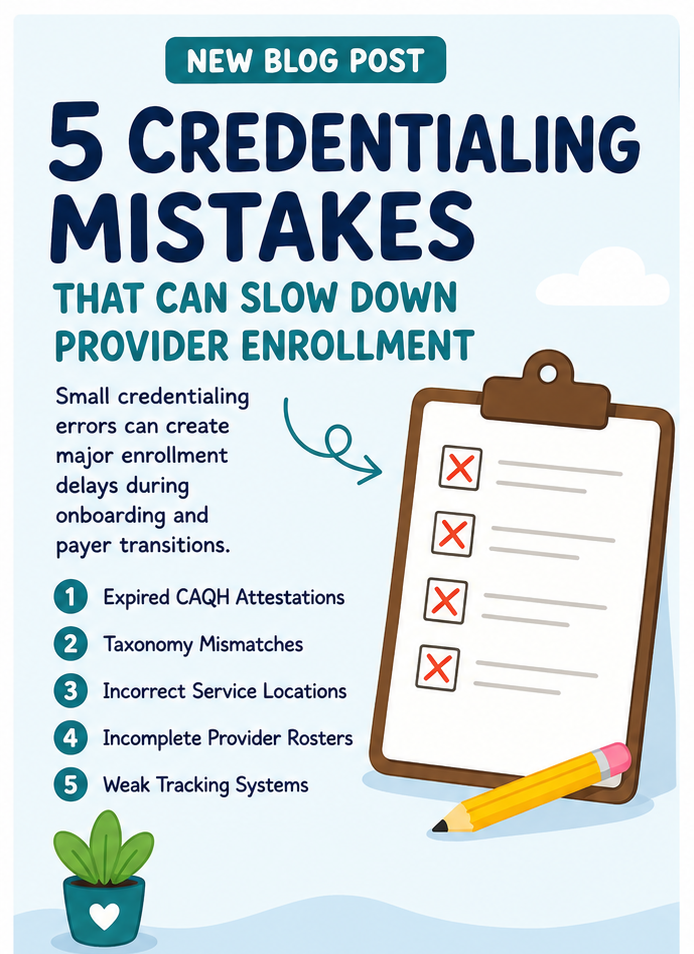
5 Credentialing Mistakes That Slow Down Provider Enrollment
- Byond Credentialing Solutions
- Feb 19
- 2 min read

Updated: May 26
By BYOND Credentialing Solutions™
Provider enrollment delays are not always caused by the payer.
In many cases, small credentialing inconsistencies can create significant administrative setbacks during onboarding, recredentialing, or payer transitions.
For ABA organizations, therapy providers, and pediatric healthcare groups, strong credentialing organization may help reduce delays and improve operational readiness.
Here are five common credentialing issues organizations should watch closely.
1. Expired CAQH Attestations
One of the most common enrollment delays occurs when CAQH profiles are not recently attested or contain outdated information.
Organizations may benefit from regularly reviewing:
attestation dates
liability insurance
work history
provider disclosures
supporting documentation
Even small discrepancies can create additional payer follow-up requests.
2. Taxonomy Mismatches
Taxonomy inconsistencies between:
NPPES
CAQH
Medicaid systems
payer applications
may contribute to enrollment delays or claim-related issues.
Organizations should verify that taxonomies accurately reflect the provider’s intended scope of services and payer participation structure.
3. Incorrect Service Locations
Address mismatches remain one of the most overlooked credentialing issues.
Differences between:
rendering locations
billing locations
practice addresses
group records
can affect:
enrollment approvals
directory accuracy
reimbursement workflows
Organizations may benefit from maintaining centralized location tracking systems.
4. Incomplete Provider Rosters
As organizations grow, payer rosters may not always accurately reflect active providers.
Missing updates involving:
new hires
terminated providers
supervising relationships
service locations
can create operational confusion during audits or payer transitions.
Routine roster audits may help organizations stay organized.
5. Weak Tracking Systems
Many organizations rely heavily on email inboxes to manage credentialing workflows.
Without centralized systems, organizations may lose visibility into:
application statuses
payer follow-ups
expiration timelines
recredentialing cycles
directory attestations
Operational organization becomes increasingly important as practices scale.
Final Thoughts
Credentialing operations impact far more than applications alone.
Strong internal systems may help organizations:
improve organization
reduce operational bottlenecks
support provider readiness
prepare for payer transitions more effectively
BYOND Credentialing Solutions provides educational resources and workflow guidance intended to help providers strengthen their internal credentialing infrastructure and stay operationally prepared.
Disclaimer
This article is intended for informational and educational purposes only. BYOND Credentialing Solutions is an independent educational resource and is not affiliated with or endorsed by any payer or government entity. Providers should verify all requirements directly with the applicable payer or regulatory organization.
Comments